

ChatGPT doesn’t hand out a #1 spot the way Google does. Visibility now depends on three levers working together: your site must be crawlable, your content has to answer the question in the first sentence, and other credible sources have to back you up. Start this week by confirming OAI-SearchBot can reach your site, rewriting one priority page to lead with a direct answer, and picking 10 to 20 prompts to track over time.
TL;DR:
- Ensuring ChatGPT can crawl your site requires checking robots.txt permissions for OAI-SearchBot and managing IP restrictions across multiple user agents.
- Improving visibility depends on rewriting key pages to lead with a direct answer and earning third-party mentions on credible sources already ranking for your prompts.
- Tracking progress through weekly logouts of 10 to 20 real buyer prompts helps measure mention rate and share of voice over time, with results visible in weeks to months.
- Technical fixes like unblocking crawler access are quick, but citation-based improvements can take several weeks to months to impact ChatGPT mentions.
- Using automated tools like CrowdReply simplifies continuous tracking, prompt research, and citation outreach, accelerating your AI search visibility efforts.
Table of Contents
- What Does “Rank in ChatGPT” Actually Mean?
- Making Your Site Eligible for ChatGPT Search
- Writing Content That ChatGPT Can Actually Quote
- Earning the Third-Party Mentions That Tip the Model Toward You
- How to Track Whether Your Work Is Actually Moving the Needle
- How Long Before You See Results?
- What Real Visibility Gains Look Like
- Where Marketers Waste Time Chasing ChatGPT Visibility
- Let CrowdReply Handle the Tracking While You Handle the Strategy
- Sources
- FAQ
What Does “Rank in ChatGPT” Actually Mean?
Google returns ten blue links ranked by position. ChatGPT synthesizes an answer from multiple sources and decides, on the fly, which ones to name and link. There’s no leaderboard to climb, which means the old mental model of “rank #1” doesn’t transfer, and chasing it wastes effort better spent elsewhere.
What replaces it are four metrics you can actually track. Mention rate is the percentage of times your brand shows up across a fixed set of prompts run over time. Position within the answer captures whether you’re named first, buried in a list, or mentioned only as an aside, since earlier mentions tend to carry more weight with users who skim. Share of voice compares your mention frequency against named competitors on the same prompts. Cited URL tells you exactly which page ChatGPT pulled from, which is the closest thing to a ranking signal you’ll get.
Here’s the tracking setup that works without buying software:
- Build a list of 10 to 20 prompts your buyers actually type, not generic keyword phrases.
- Run each prompt weekly in a logged-out session so personalization and memory don’t skew results.
- Log five columns: date, prompt, whether you were mentioned, competitor names in order of appearance, and the cited URL.
- Calculate mention rate (mentions divided by total prompts run) and share of voice (your mentions divided by total brand mentions across the set).
- Review trends monthly, not daily. A single week of data is noise, not signal.
Logged-out sessions matter more than most marketers assume. ChatGPT’s answers shift based on session history and account context, so a logged-in test reflects your own browsing habits, not what a fresh prospect sees.
Making Your Site Eligible for ChatGPT Search
Before worrying about phrasing or formatting, confirm ChatGPT can even see your pages. This is a binary gate: fail it, and no amount of clever copywriting matters. OpenAI has confirmed there’s no way to guarantee top placement in ChatGPT Search, but you can absolutely guarantee exclusion by blocking the wrong crawler.
Three separate user agents matter here, and they’re often confused. OAI-SearchBot indexes content specifically for ChatGPT Search. GPTBot crawls content for model training. ChatGPT-User fetches pages in real time when a user asks a question that triggers browsing. Each has its own published IP ranges, so blocking one doesn’t necessarily block the others, and you need to manage them individually in robots.txt.
Run through this checklist:
- Confirm your robots.txt explicitly allows OAI-SearchBot; don’t assume a blanket “Allow: /” covers it if you’ve also got Disallow rules targeting bot categories.
- Check your CDN or firewall (Cloudflare, Akamai, and similar services often ship with aggressive bot-blocking defaults) to make sure OpenAI’s published IP addresses aren’t caught in a blanket “block AI scrapers” rule.
- Verify your core answer content renders in the initial HTML response, not injected client-side by JavaScript after the page loads.
- Use semantic HTML (proper heading hierarchy,
<article>tags, clear paragraph structure) so extraction tools can parse meaning, not just text.
Passing a Google crawlability check does not mean you pass this one. Google’s indexer and OpenAI’s retrieval system are entirely separate pipelines, and a page can rank fine on Google while being invisible to ChatGPT Search if OAI-SearchBot is blocked or the content loads via JavaScript the crawler doesn’t execute.
Pro Tip: After updating robots.txt, wait before panicking. OpenAI notes that changes can take roughly 24 hours to propagate through their systems, so test again the next day rather than assuming the fix failed.
Writing Content That ChatGPT Can Actually Quote
Getting crawled is step one. Getting quoted requires content shaped for extraction, not just readability. A model pulling together an answer favors passages that already look like an answer: short, self-contained, and stripped of throat-clearing.
The pattern that works consistently: write an H2 as a real question, then answer it in one sentence directly underneath, before any supporting detail. “What Does ChatGPT Ranking Depend On?” followed immediately by a clean, factual sentence gives the model something it can lift whole. Bury that same fact three paragraphs into a narrative introduction, and it’s far less likely to surface.
Structured data plays a supporting role here. Marking up pages with schema.org types like Article, FAQPage, or Product doesn’t guarantee inclusion, but it makes facts like prices, dates, and specifications machine-readable rather than something the model has to infer from prose.
A few formatting habits worth adopting:
- Lead every major section with the direct answer, then expand with evidence or nuance afterward.
- Use FAQ schema on pages that already answer common questions in Q&A format.
- Keep comparison tables factual and specific rather than vague marketing language dressed up as data.
- Avoid stuffing a page with ten related questions when three answered well would extract more cleanly.
Listicle and comparison formats get quoted disproportionately. Structured, answer-first passages increase extractability, and models tend to lift content that already resembles the shape of an answer rather than content buried in narrative. That doesn’t mean padding a page with a numbered list for its own sake. A comparison page built around genuine distinctions between options gets cited; one built to game the format with fluff typically doesn’t hold up when a model checks it against other sources.
Earning the Third-Party Mentions That Tip the Model Toward You
Your own site is only half the equation. A large share of what ChatGPT cites comes from external editorial and community pages rather than brand-owned domains, which means digital PR and community presence carry as much weight as on-site optimization, sometimes more.
This tracks with how these models work. When corroborating a claim, a model that finds your brand mentioned across several independent, credible sources treats that as a stronger signal than a single self-published page making the same claim. Earning citations through targeted outreach to sites that already rank for your target prompts is often faster than waiting for your own domain authority to build.
A campaign that actually moves the needle looks like this:
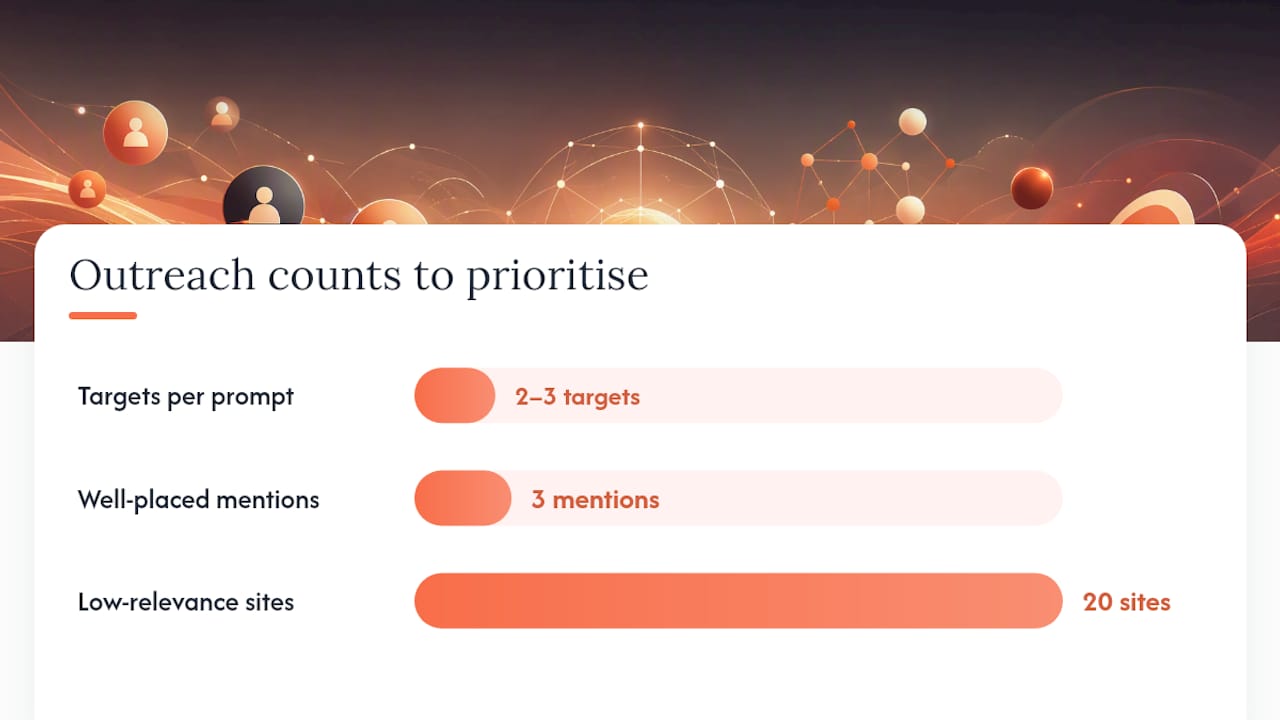
- Identify 2 to 3 existing listicles or comparison posts already ranking for prompts you care about.
- Pitch the editor with one extractable, factual bullet about your product, not a generic press release.
- Get the mention placed, ideally with a link back to a specific, answer-ready page on your site.
- Add that prompt to your weekly tracking list and watch for whether the new citation shows up in ChatGPT’s answers within a few weeks.
Community platforms deserve the same attention as press outreach. Reddit threads, Quora answers, and niche forum discussions frequently get pulled into AI-generated answers because they read as unfiltered, third-party opinion rather than marketing copy. Review sites function the same way: a handful of detailed, specific reviews often outweighs a polished but generic testimonials page.
Pro Tip: Don’t spread outreach across 20 low-relevance sites. Three well-placed mentions on pages that already rank for your target prompts will move your citation rate faster than a scattershot campaign.
How to Track Whether Your Work Is Actually Moving the Needle
Run the same 10 to 20 prompts every week, in a fresh logged-out session, and log the same five data points every time: date, prompt, mention (yes or no), competitor order, and cited URL. Consistency in the prompt list matters more than the exact number you choose. Swapping prompts week to week makes trends impossible to read.
From that log, two formulas do the real work:
- Mention rate = number of prompts where you appeared ÷ total prompts run that week.
- Share of voice = your mentions ÷ total brand mentions across all competitors on the same prompt set.
Expect noise before you see signal. A single week’s data can swing based on which model version answered, whether browsing mode was active, or regional variation in results. Give it at least four to six weeks of consistent sampling before drawing conclusions about whether a specific tactic, like a new backlink or a rewritten page, actually changed anything.
Manual tracking in a spreadsheet works fine at small scale, but it gets tedious past a handful of prompts or competitors. When you’re running more than 20 to 30 prompts, watching several competitors, or need historical trend charts instead of a static log, that’s the point to consider a dedicated ChatGPT rank tracker built for exactly this kind of sampling. Look for tools that report cited URLs specifically, not just whether your brand name appeared somewhere in the text.
How Long Before You See Results?
Technical fixes move fast. Fixing a blocked robots.txt directive or an IP allowlist issue can restore eligibility within days once changes propagate. Content and citation work moves slower, often taking several weeks to a few months before you see a measurable shift in mention rate, because it depends on external sites publishing, indexing, and the model incorporating that corroboration into its answers.
Expect variability along the way. Model version updates, whether browsing mode is active, session memory, and even regional differences all introduce noise that has nothing to do with your work.
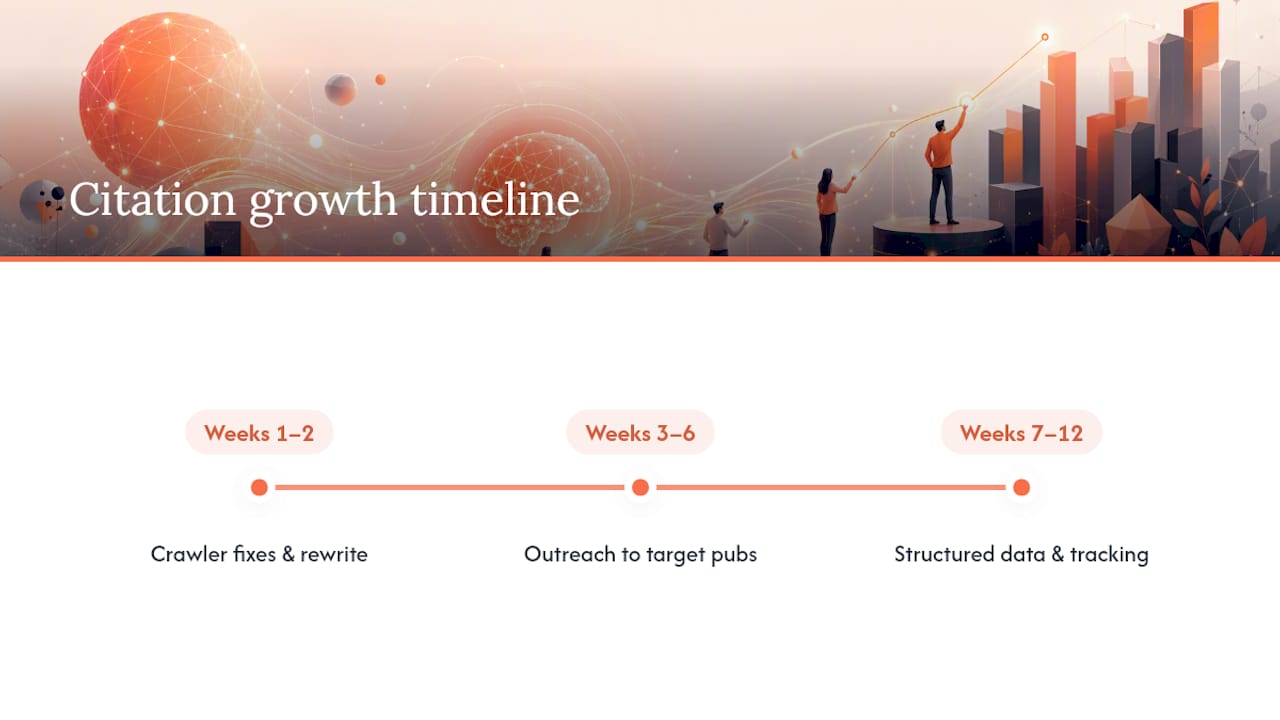
A realistic 90-day sequence: weeks one and two, fix crawler access and rewrite your highest-priority page to answer-first. Weeks three through six, launch outreach to two or three target publications. Weeks seven through twelve, expand structured data across key pages and start weekly tracking in earnest, watching for the first citation shifts to appear.
What Real Visibility Gains Look Like
The numbers behind this playbook aren’t theoretical. Brands running structured AI visibility programs have reported significant increases in visibility and over a million dollars in attributed revenue after prioritizing crawler access, answer-first rewrites, and citation outreach in sequence.
One case worth studying: a brand called Lido went from zero visibility to appearing in a notable share of tracked ChatGPT prompts after applying this exact sequence, tracked using the same mention rate and share of voice framework covered above. The full case study walks through which prompts moved and which citations drove the shift.
The tools that map most directly to this playbook:
- A visibility tracker for the weekly prompt sampling described earlier, without building your own spreadsheet from scratch.
- Prompt research to identify which buyer questions you’re currently missing entirely, not just the ones you already rank for.
- A citation outreach system to manage the listicle and PR pitching campaign at scale, rather than one email at a time.
Where Marketers Waste Time Chasing ChatGPT Visibility
Most teams get this backward. They spend weeks perfecting answer-first copy on a page that OAI-SearchBot can’t even reach because a CDN rule blocked it eight months ago and nobody checked. Fix crawler access first. Rewrite one page to be genuinely extractable second. Everything else is downstream of those two moves.
Watch for these red flags: drawing conclusions from a single week of prompt data, treating any AI crawler as hostile traffic to block by default, and ignoring third-party citations because they feel harder to control than your own site. They’re harder, and they matter more.
Thirty-day checklist: verify OAI-SearchBot access, rewrite your top page, pick your prompt list, and pitch two publications.
— Jim
Let CrowdReply Handle the Tracking While You Handle the Strategy
Crowdreply is the alternative to guessing at your ChatGPT visibility with manual spreadsheet checks. Instead of running prompts by hand every week, you get daily scans across ChatGPT, Gemini, Perplexity, Google AI, and Copilot, with mention rate, share of voice, and cited URLs tracked automatically.
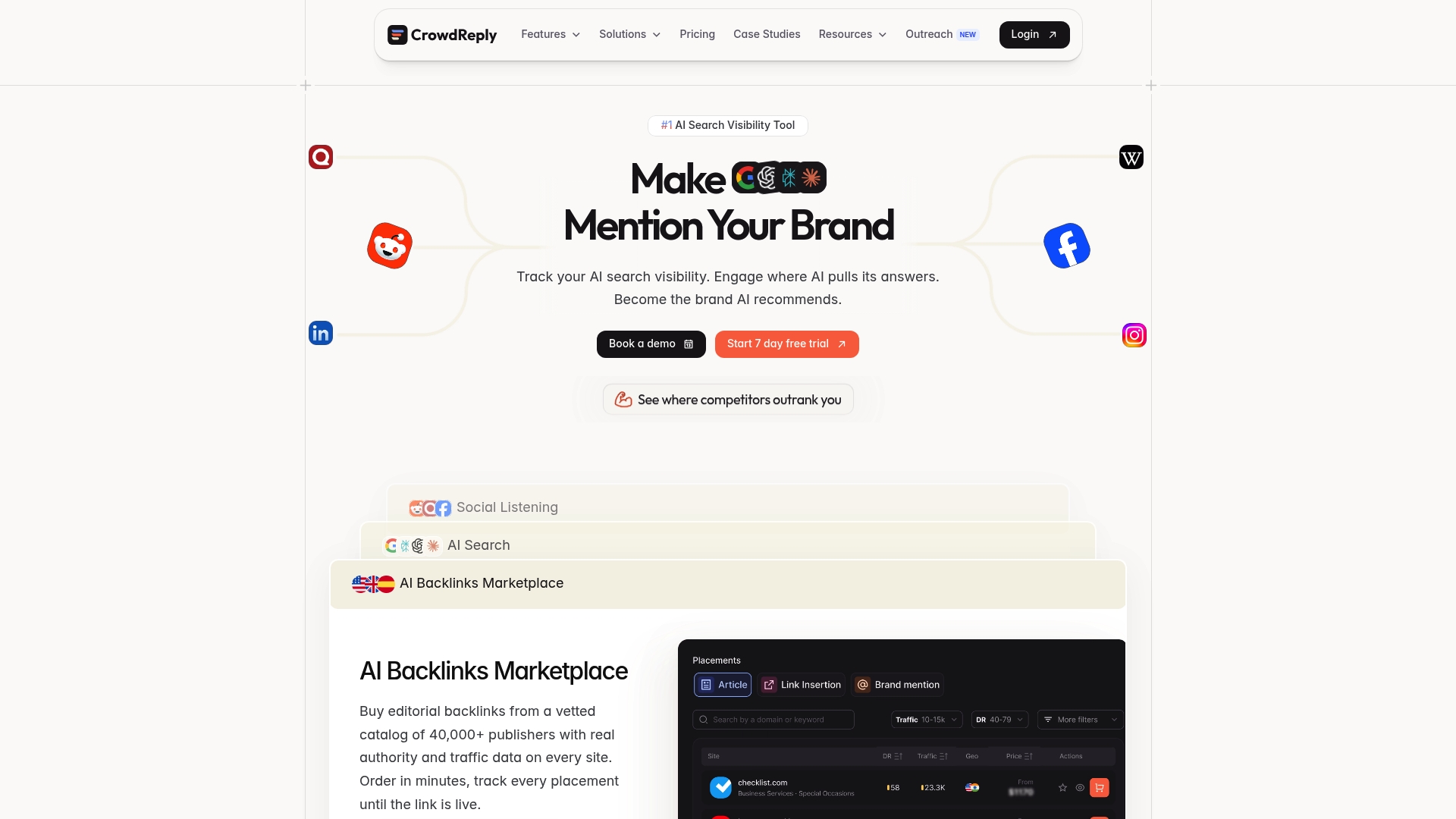
The platform maps directly onto the playbook covered here. Prompt research surfaces the buyer questions you’re currently missing. The visibility tracker replaces the manual weekly log with continuous scans. And when you’re ready to earn the third-party citations that tip a model toward naming you, the AI Backlinks Marketplace connects you with vetted sources instead of cold-pitching editors one at a time.
Start with a free visibility audit to see where your brand currently stands across AI search engines, then check the pricing page for current plan details and pricing.
Sources
Confirm crawler behavior directly against OpenAI’s own documentation rather than secondhand summaries. The overview of OpenAI crawlers lists user agents and published IP ranges for OAI-SearchBot, GPTBot, and ChatGPT-User. The ChatGPT Search Help Center article explains inclusion requirements directly from OpenAI. For deeper tactical reading, the AEO Labs playbook and Seofable’s guide cover format-specific tactics in more detail.
- Overview of OpenAI Crawlers
- ChatGPT Search | OpenAI Help Center
- How to Rank in ChatGPT: The 2026 Playbook | AEO Labs
FAQ
How Do I Rank in ChatGPT?
Focus on three things at once: make sure OAI-SearchBot can crawl your site, rewrite your key pages to answer questions in the first sentence, and earn mentions on third-party sites that already rank for your target prompts. OpenAI confirms there’s no way to guarantee placement, so the goal is raising your mention rate across a fixed prompt set, not chasing a single fixed position.
Which AI Is Ranked the Highest?
There’s no single ranking of AI models, since each one (ChatGPT, Gemini, Perplexity, Copilot) pulls from different sources and weighs citations differently. Tracking your visibility across all of them individually, using tools like a competitor analysis tracker, gives a clearer picture than assuming one platform’s results predict another’s.
What AI Is Better Than ChatGPT?
No AI model is universally “better” for search visibility purposes. Perplexity leans heavily on real-time web citations, Gemini draws from Google’s index, and ChatGPT Search depends on OAI-SearchBot access, so a brand invisible in one can be well cited in another depending on which technical and content gaps it has closed.
How Fast Can You Rank on ChatGPT?
Technical fixes like unblocking OAI-SearchBot can restore eligibility within days once your robots.txt update propagates, which OpenAI says takes about 24 hours. Citation-driven visibility gains, the kind that come from third-party mentions and answer-first rewrites, typically take several weeks to a few months to show up in your mention rate.
What Does CrowdReply Cost?
CrowdReply’s Starter plan runs $79 a month, Growth is $239 a month, and Enterprise starts from $399 a month, all listed on the pricing page. One-off editorial mentions through the backlinks marketplace range from $7 to $25 depending on whether you’re purchasing a comment, a comment with a link, or a full post.
Leave a Reply