
AI reputation management means controlling how ChatGPT, Perplexity, Gemini, and Google AI name, describe, and cite your brand when buyers ask questions in your category. The first move is not a content calendar. It’s a baseline: run 20 to 30 real buyer prompts across those engines this week and record which brands get named and which URLs get cited.
TL;DR:
- Most AI citations about brands come from third-party sites, making owned-page SEO insufficient without targeted outreach to high-citation domains.
- Regular weekly sampling across multiple AI engines is essential to accurately measure and improve a brand’s mention and citation share.
- Ensuring your website is technically accessible to AI crawlers requires checking robots.txt, page speed, and proper content structuring, as some engines may ignore blocked sites.
- Fast citation gains can be achieved by creating answer-focused passages with embedded facts, quotes, and list formats, while building a parametric consensus takes longer through consistent third-party coverage.
- Automating sampling and backlink outreach through tools like CrowdReply helps maintain baseline visibility and scales smaller teams’ efforts effectively.
Table of Contents
- What Does AI Reputation Management Actually Cover?
- Why Do Third-Party Domains Drive Most AI Citations?
- How Do You Measure Baseline AI Visibility?
- Is Your Site Even Eligible to Be Cited?
- What Tactics Move Citations Fastest, and What Takes Longer?
- How Often Should You Check Your AI Visibility?
- What Do Real Visibility Gains Look Like?
- What Actually Matters in the First 90 Days?
- How CrowdReply Turns This Playbook Into a Weekly Habit
- Sources
- FAQ
What Does AI Reputation Management Actually Cover?
AI reputation management is not the same discipline as classic online reputation management, which chases star ratings and review responses. This is about whether a large language model mentions your brand at all, and whether it links to a page you control or a page someone else wrote about you.
Three layers matter here: mentions (your brand name appears in the answer), citations (a specific URL gets linked as the source), and owned-page presence (your own site is the thing being cited, versus a third party writing about you). Engines differ enough that a strategy built for one can fail on another, which is why this article treats ChatGPT, Perplexity, Gemini, and Google AI Overviews as separate channels rather than as one blended “AI search” bucket.
Why Do Third-Party Domains Drive Most AI Citations?
Roughly 85.7% of the URLs AI assistants cite point to sites the brand doesn’t own, according to research on the sourcing patterns behind AI brand citations. Your own website is rarely the thing an LLM links to when it talks about you. Someone else’s writeup, comparison, or roundup usually is.
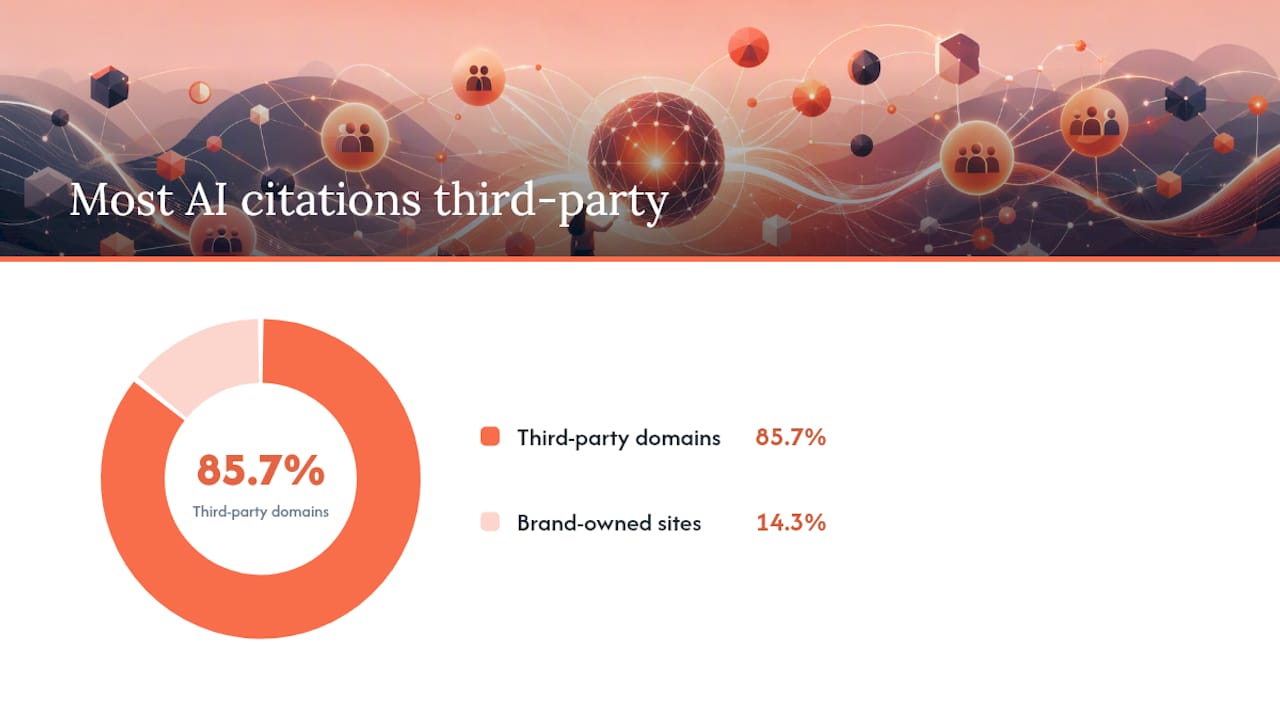
That research also found a Zipf-like concentration where a large majority of citations come from a relatively small portion of domains. A small head of publishers, review sites, and industry hubs supplies most of the citation volume in any given category.
Nearly all AI citations about a brand come from sources the brand does not control. Owned-page SEO alone cannot fix a citation gap.
The operational takeaway is straightforward:
- Identify the handful of domains that already get cited repeatedly in your category
- Pursue earned placement there instead of spreading outreach thin across dozens of minor sites
- Favor citation-friendly formats: comparison lists, roundups, and interview transcripts get pulled into answers more often than plain narrative pages
- Adjust the hunt by engine, since Perplexity tends to pull from discussion-heavy sources like forums and review threads, while ChatGPT leans toward long-form editorial
Pro Tip: Pull the list of domains already cited for your top three competitors before you pitch anyone. That list is your outreach target list, built for free.
How Do You Measure Baseline AI Visibility?
You can’t manage what you haven’t measured, and screenshotting a single ChatGPT answer tells you almost nothing. Citations are probabilistic. The same prompt run twice can return different sources, which is why a one-time check is close to useless and repeated sampling is the only honest way to measure AI visibility.
Here’s a method you can run this week:
- Write 20 to 30 prompts in actual buyer language, the kind of questions a prospect types before they’ve heard of you, not your own marketing copy.
- Run each prompt, unchanged, across ChatGPT, Perplexity, Gemini, and Google AI.
- Record whether your brand is named, which URLs get cited, and how that varies by engine.
- Calculate mention share (how often you’re named versus competitors) and citation share (how often your content, or content about you, is the linked source).
- Repeat weekly for the first month to see whether results are stable or noisy.
Assign this to someone by name, not “marketing.” A ChatGPT visibility tracker or Gemini visibility tracker makes the weekly run fast; a spreadsheet works too, it just costs more hours. Aggregate monthly, review strategy quarterly.
Is Your Site Even Eligible to Be Cited?
Before you invest in content or outreach, confirm the engines can actually read your pages. This is the fastest fix available, and most teams skip it.
- Check
robots.txtfor OAI-SearchBot, PerplexityBot, GPTBot, and Google-Extended, and confirm none are blocked. - Serve your primary content in server-side HTML. If the page body only appears after JavaScript renders, several crawlers never see it.
- Keep pages fast. Slower first contentful paint correlates with fewer citations in comparative studies of AI search behavior.
- Structure key facts as short, self-contained passages, not buried three paragraphs deep in a sidebar.
- Test it directly: request the page through the engine’s fetch or inspection tool, then run a prompt that should surface it and see if it does.
Pro Tip: Perplexity’s user-triggered fetches sometimes ignore robots.txt entirely, according to testing on optimizing for ChatGPT and Perplexity. Don’t assume a blocked crawler means zero Perplexity visibility. Verify it live instead of trusting the file.
What Tactics Move Citations Fastest, and What Takes Longer?
Split your effort into two tracks that run in parallel, not in sequence.
Fast wins target passage-level retrieval. These can shift citations within weeks:
- Write answer-first passages: state the fact or answer in the first sentence, then support it, rather than building up to a conclusion.
- Embed a specific statistic or named source in every key passage. Controlled tests show adding quotes and data to a page can lift generative-answer visibility by roughly 40%.
- Format claims as lists, tables, and short quotable summaries under 400 tokens. That’s the shape retrieval systems favor when reranking passages.
- Pitch the owners of existing roundups, comparison posts, and interview transcripts already cited in your category, rather than waiting for them to find you.
Slow wins build parametric consensus, the deeper pattern a model learns from repeated exposure to consistent facts about you across many independent sources. That means the same entity description (what you do, who you serve, what makes you different) showing up the same way across your own site, press coverage, and third-party listings, plus a steady drip of earned coverage on the head domains identified earlier.
Pro Tip: Match tactics to the engine. ChatGPT tends to cite fewer sources but weight each one more heavily, so depth and authority on one strong placement matter more than volume. Perplexity cites broadly, so breadth of coverage across discussion sites pays off faster there. Google AI Overviews largely mirror core Search rankings, so your existing SEO work still counts.
How Often Should You Check Your AI Visibility?
Weekly sampling catches signal before it becomes a trend you missed. Monthly aggregation smooths out the noise from any single probabilistic run. Quarterly reviews are where you decide whether the strategy needs to change.
Track a short KPI set instead of a sprawling dashboard:
- Mention share across your sampled prompt set, by engine
- Citation share (how often you’re the linked source versus just named)
- Engine coverage breadth, since 78.2% of cited URLs in one study appeared on only one of four engines tested
- Share of your citations coming from head domains versus long-tail sites
- AI-referred traffic that converts, tracked in analytics as a distinct channel
Name an owner for this before you start. Someone needs to run the sampling, someone needs to own outreach, and someone needs to connect AI-referred sessions to pipeline, or the whole exercise stays a reporting exercise instead of a growth lever.
What Do Real Visibility Gains Look Like?
Reported outcomes from brands running this playbook consistently give a sense of the ceiling. CrowdReply’s case study work documents a 47% visibility increase and more than $1 million in attributed revenue in one instance tied to improved AI search rankings.
It came from sustained sampling, targeted earned placements on domains already trusted by the engines, and editorial backlinks that reinforced consistent entity framing.
The operational pattern behind these results repeats:
- Establish a cross-engine baseline before touching content or outreach
- Prioritize earned coverage on the small set of domains that already get cited in the category
- Use editorial backlinks to reinforce consistent brand framing rather than chasing random placements
- Re-measure on the same cadence to confirm the gain holds across engines, not just one
Smaller teams shouldn’t expect identical percentages. Budget and existing domain authority both shape the ceiling. But the sequence, baseline first, then targeted earned coverage, then re-measurement, scales down to a single-person marketing team just as it scales up to an enterprise brand.
What Actually Matters in the First 90 Days?
Spend quarter one on the boring parts: technical eligibility, a real baseline, and one or two head-domain placements done well. The trap almost every team falls into is optimizing their own site for months while ignoring that 85.7% of citations come from somewhere else entirely. The other trap is treating one engine’s win as proof of a working strategy. It usually isn’t, since most cited sources don’t carry over between engines.
— Jim
How CrowdReply Turns This Playbook Into a Weekly Habit
Running cross-engine sampling by hand every week is the part most teams quietly abandon by month two. That’s the specific gap Crowdreply closes: it automates the sampling, citation tracking, and prompt research this article just walked through, so the baseline stays current without someone manually copy-pasting prompts into four different chat windows.
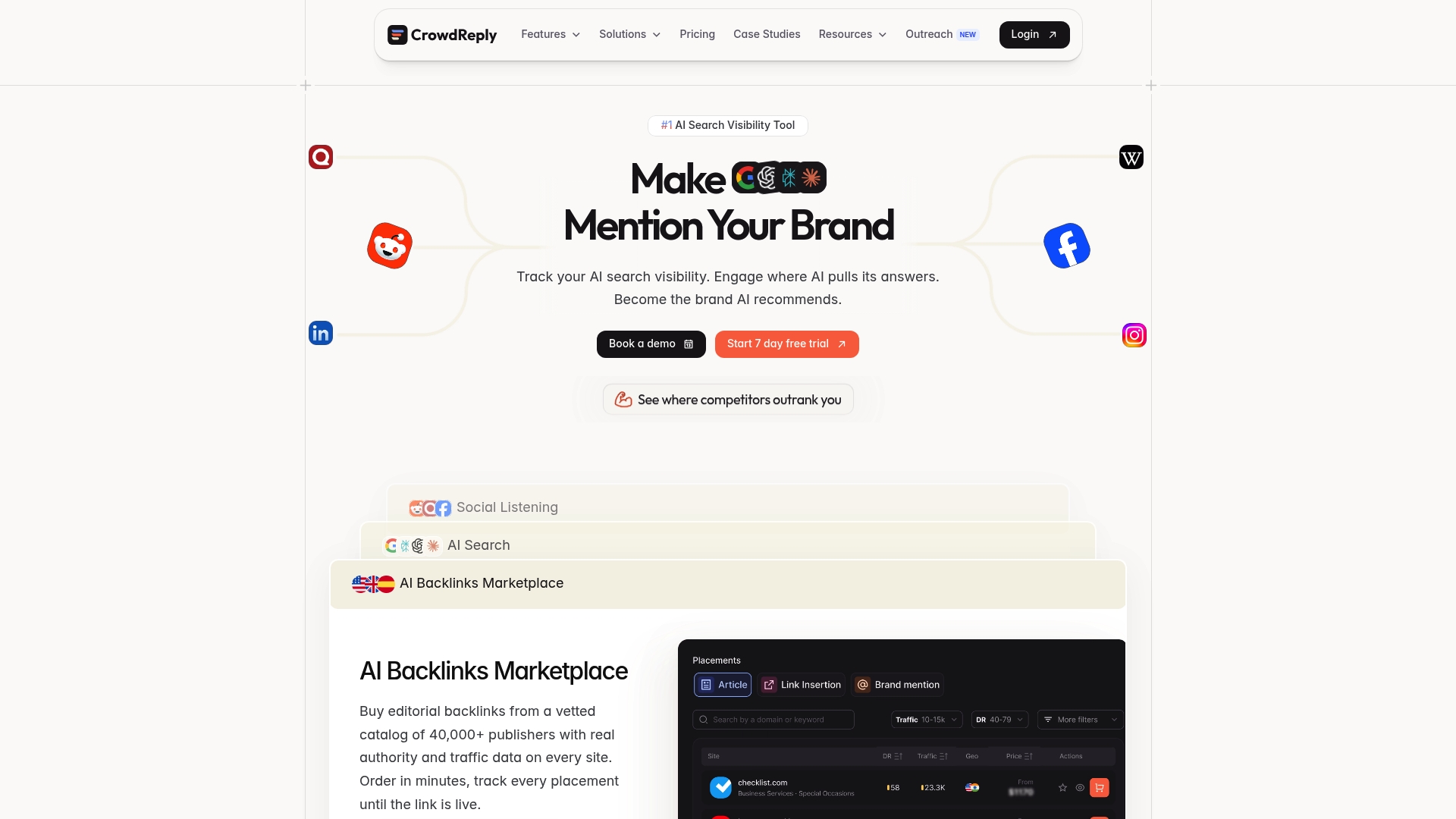
The platform runs daily scans across ChatGPT, Perplexity, Gemini, Google AI, and Copilot, tracks which domains are citing you (and your competitors), and flags prompt gaps where you’re getting zero mentions in a topic you should own. Case studies like Respeecher’s jump from 47% to 82% visibility and Lido’s climb from 0 to 15% on ChatGPT show the sampling and outreach approach in this article applied at scale, with the head-domain outreach handled through Crowdreply’s AI backlinks marketplace instead of a manual pitch list.
Plans start at $79 a month on the Starter tier, with Growth and Enterprise tiers adding deeper competitor tracking and engagement tools as your prompt list grows. If you want to see where your brand currently stands before committing to anything, run a visibility check against your own buyer prompts and see what’s already getting cited, and what isn’t.
Sources
- The sourcing patterns behind AI brand citations (arXiv)
- AI search visibility: engine differences and optimization (HubSpot)
- AI search visibility: how to measure presence in LLM answers (Is My Brand In AI)
FAQ
What Is AI Reputation Management?
AI reputation management is the practice of tracking and improving how AI assistants like ChatGPT, Perplexity, and Gemini name and cite your brand in response to buyer questions. It’s distinct from traditional online reputation management, which focuses on reviews and star ratings rather than citations inside AI-generated answers.
How Is This Different From Traditional SEO?
Traditional SEO targets ranking positions in a search results page you control through your own site. This discipline targets whether an LLM mentions you at all and whether it links to your page or a third party’s, and 85.7% of the time it’s a third party’s.
How Often Should We Check Our AI Visibility?
Sample weekly for the first month to establish a stable baseline, then aggregate monthly and review strategy quarterly. Weekly checks matter because citations are probabilistic and can shift between identical prompt runs.
Which AI Engines Should We Prioritize First?
Prioritize the engine where your buyers actually ask questions, since most cited sources don’t overlap across engines. ChatGPT rewards fewer, higher-authority sources; Perplexity rewards breadth; Google AI Overviews largely track your existing Search rankings.
Does CrowdReply Track All the Major AI Engines?
Crowdreply runs daily scans across ChatGPT, Gemini, Perplexity, Google AI, and Copilot, tracking mentions, citation sources, and share of voice against competitors. Current pricing starts at $79 a month for the Starter plan.
Leave a Reply