

AI trust signals are the verifiable markers ChatGPT, Claude, Perplexity, and Gemini use to decide which brands and sources deserve a citation. The single highest priority for marketers is earning third-party corroboration and publishing verifiable provenance, since models weigh independent confirmation far more heavily than anything a brand says about itself. What follows is an audit framework and a 30/60/90 roadmap for closing the gaps.
TL;DR:
- Verifiable provenance signals such as methodology disclosure, named authorship, and source citations have the highest impact on AI citation and trustworthiness.
- Building entity consistency across directories, adding schema markup, and rewriting key pages into extractable passages are the most effective immediate fixes.
- Outdated or fabricated trust signals, such as fake credentials or fake mentions, can severely damage credibility and may lead to legal or reputational risks.
- Different AI models prioritize trust signals differently, with ChatGPT favoring familiarity, Claude rewarding primary sources, and Perplexity emphasizing freshness.
- Ongoing measurement of citation rate, earned mentions, and schema validation is essential to track and improve your AI visibility strategy.
Table of Contents
- What Are AI Trust Signals, Exactly?
- The Five Signal Categories, With Real Examples
- Which Provenance Signals Move the Needle Most?
- What Should You Fix First?
- Do ChatGPT, Claude, Perplexity, and Gemini Weigh Signals the Same Way?
- How Do You Track Progress on AI Trust Signals?
- What Happens When Trust Signals Are Faked?
- What Legal and Ethical Lines Apply Here?
- Perspective: Winning AI Citations Takes a Cross-Functional Team
- Close the Gaps Crowdreply Finds in Your AI Visibility
- Sources
- FAQ
What Are AI Trust Signals, Exactly?
AI trust signals are the pieces of evidence a language model uses to judge whether a claim, a brand, or a page is worth citing in its answer. They matter because AI-driven answers skip the ten-blue-links format entirely. There’s no ranking position to fight for, only a binary: cited or not cited.
That reframes the whole game. Traditional SEO leaned on backlinks, domain authority, and keyword density. AI systems care less about link volume and more about whether an entity can be verified across independent sources. A model self-report on provenance signals found that methodology sections, named authorship, and inline citations score highest among the signals models actually weigh when deciding what to cite.
Most trust signals fall into five categories:
- Entity identity — is this brand or author clearly and consistently identified across the web?
- Earned authority — has anyone besides the brand vouched for it?
- Content extractability — can a model pull a clean, self-contained answer from the page?
- Technical accessibility — can crawlers and retrieval systems actually parse the content?
- Freshness — does the content reflect current, verifiable information?
Backlinks still count, but mostly as one input into earned authority, not the whole game.
The Five Signal Categories, With Real Examples
Each category above translates into specific, checkable items. Here’s what they look like in practice.
Entity identity shows up as consistency: the same business name, address, and description on Wikidata, Google Business Profile, LinkedIn, and your own site, tied together with sameAs markup pointing to each profile.
Earned authority means press mentions, third-party reviews, and citations from industry publications that didn’t originate with your marketing team. Industry data suggests earned third-party coverage drives most AI citations, often more than any owned content a brand publishes.
Content extractability is about format. Short, self-contained passages that answer one question directly, FAQ pairs, and inline citations all give a model something clean to lift into its response.
Technical accessibility covers JSON-LD for Organization and Author, semantic HTML with a single H1, and page speed that doesn’t choke a crawler. Pages carrying Article, FAQPage, and Organization schema are cited noticeably more often than pages without it.
Freshness means visible last-updated timestamps and edits that actually change the substance of a page, not a cosmetic date bump.
Pro Tip: Run your own homepage and one flagship article through a schema validator today. Missing Organization markup is the single most common gap teams find in their first audit.
Which Provenance Signals Move the Needle Most?
Not all trust signals carry equal weight. Provenance signals, the ones that let a reader or a model trace exactly how a claim was verified, punch far above their weight class because almost nobody bothers to publish them.
Four signals matter most, in roughly this order:
- Methodology disclosure. A short “how we know this” section acts as a show-your-work moment. It tells a model the claim wasn’t asserted out of thin air.
- Named authorship with credentials. A real name attached to real expertise gives a model something to verify against other sources.
- Inline and source citations. Every factual claim linked to its origin builds what researchers call a verification chain, and models consistently prefer content that supplies one.
- Publication and last-updated timestamps. Dated content reduces the uncertainty a retrieval system has to resolve on its own.
The same self-report study that ranked these signals scored methodology sections at 8.5 out of 10 for citation impact, with named authorship and inline citations close behind at 7.5 each, according to the SIGI research on authority and provenance signals. Separate research on veracity classification found that credibility signals like these map strongly to actual accuracy across a majority of the datasets tested. Methodology disclosure is rare in marketing content today, which is exactly why it works: almost no competitor is doing it.
What Should You Fix First?
Not every fix deserves the same urgency. Some take an afternoon; others take a quarter. Sort by impact divided by effort, and start with whatever scores highest.
- Fix entity consistency across directories. Mismatched names, addresses, or descriptions between your site, Google Business Profile, and LinkedIn confuse both crawlers and models. This is usually a same-day fix.
- Add Organization and Author schema. JSON-LD markup gives models a machine-readable identity to anchor to, using the vocabulary Schema.
- Rewrite key pages into extractable passages. Break dense paragraphs into direct, self-contained answers and add FAQ schema where it fits.
- Pursue earned mentions through PR and outreach. This takes longer, but third-party coverage remains the highest-leverage category long-term.
- Publish methodology and author-credential pages. These are underused, which makes them a real differentiator once live.
Pro Tip: Treat weeks 1 through 30 as the cleanup sprint (entity consistency, schema, extractable copy), days 31 through 60 as the outreach sprint (press, reviews, citations), and days 61 through 90 as the measurement sprint (tracking citation rate and iterating).
Do ChatGPT, Claude, Perplexity, and Gemini Weigh Signals the Same Way?
They don’t, and treating them identically wastes effort. Each engine leans on a different mix of training data and live retrieval, so the same trust signal doesn’t carry equal weight everywhere.
- ChatGPT leans on training-data familiarity, so consistent entity coverage built up over time and historical authority matter more than a page published last week.
- Claude tends to favor depth and primary sources, rewarding content that cites original research over content that summarizes someone else’s summary.
- Perplexity pulls from live search results, so freshness and community signals like recent reviews or forum mentions carry outsized weight.
- Gemini and Google AI Mode align closely with traditional E-E-A-T signals, meaning your existing SEO fundamentals still matter here more than on the others.
If you only have bandwidth for one engine-specific move, prioritize primary-source depth for Claude and freshness for Perplexity. Both are cheaper to fix than rebuilding years of training-data familiarity.
How Do You Track Progress on AI Trust Signals?
You can’t manage what you don’t measure, and AI visibility has its own metric set distinct from classic SEO dashboards.
- AI citation rate tracks how often your brand or content gets cited across a defined set of prompts.
- Earned mention volume counts independent, third-party references to your brand appearing anywhere online.
- Schema validation pass rate measures the share of your key pages carrying clean, error-free structured data.
- Share of voice compares your citation frequency against named competitors across the same prompt set.
A sound monitoring workflow runs daily scans across multiple models, flags new mentions as they appear, and tracks the verification chain back to source.
What Happens When Trust Signals Are Faked?
Fabricating trust signals is tempting because some of them look easy to game. It backfires faster than most marketers expect.
Fake credentials are the most common failure. A brand invents a named “expert” or attaches credentials nobody can verify. Models cross-reference entities against multiple sources, and an author who doesn’t exist anywhere else on the web (no LinkedIn, no other bylines, no citation trail) reads as a red flag rather than a trust boost. The same logic applies to fabricated review counts or purchased testimonials that don’t match any public review platform.
Manufactured “earned” mentions carry similar risk. Paying for low-quality guest posts stuffed with brand mentions, or seeding fake forum discussions, might briefly inflate mention volume. But these sources tend to cluster in obviously low-authority domains, and once a model or a human fact-checker notices the pattern, it damages every other signal from that domain going forward.

Fake methodology sections are perhaps the riskiest move of all, precisely because methodology carries so much weight. Writing a “how we tested this” section for a test that never happened isn’t just a trust-signal failure. It’s a factual misrepresentation that can expose a brand to real legal and reputational consequences if discovered.
The safer path is slower but durable: build entity consistency honestly, earn coverage through actual PR work, and only publish methodology you can defend if someone asks for the underlying data. Trust signals compound over time. Fake ones collapse the moment anyone checks.
What Legal and Ethical Lines Apply Here?
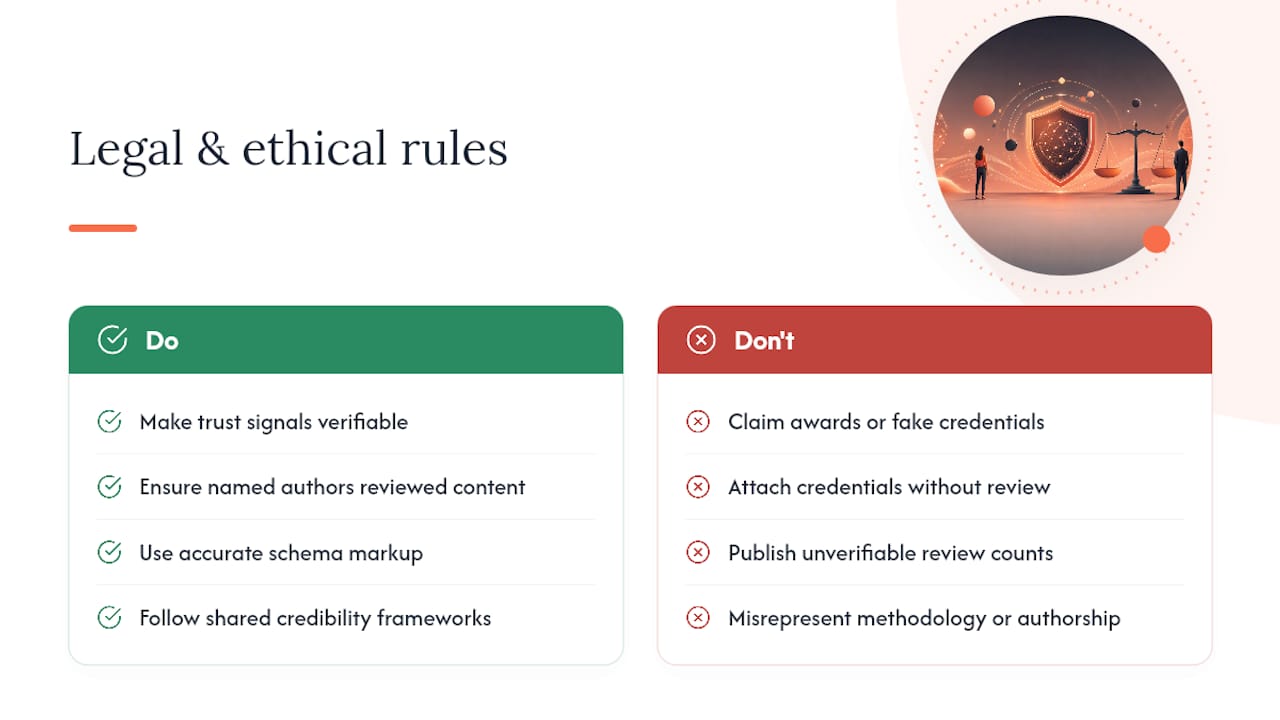
Publishing trust signals sits closer to consumer protection law than most marketers assume. Claims implying independent verification, awards, or credentials that don’t exist can trigger the same false-advertising scrutiny that applies to any other marketing claim, regardless of whether an AI model or a human reads it first.
Named authorship raises its own question: if you attach a real person’s name and credentials to content, that person should have genuinely reviewed or contributed to it. Attaching a credentialed name to content they never touched is a misrepresentation of expertise, not a growth hack.
Schema markup carries a quieter risk too. Structured data that claims review counts, ratings, or organizational details inconsistent with what’s publicly verifiable can mislead both users and the platforms parsing that data, and search engines have historically penalized exactly this kind of markup abuse.
The ethical baseline is simple: every trust signal you publish should be reconstructable by an outside party. If a journalist, a regulator, or a curious customer tried to verify your methodology section, your author credentials, or your review counts, they should land on evidence that holds up. Frameworks like the W3C’s credibility signals taxonomy exist precisely because credibility infrastructure needs shared, checkable definitions rather than brand-by-brand self-assessment. Treat that as the standard to build toward, not a compliance hurdle to route around.
Perspective: Winning AI Citations Takes a Cross-Functional Team
Machine relations can’t sit inside one department. PR earns the mentions, content builds the extractable pages, and analytics tracks whether any of it moved citation rate. Report three numbers to leadership monthly: citation rate, earned mention volume, and schema pass rate. Anything less leaves the effort unaccountable.
— Jim
Close the Gaps Crowdreply Finds in Your AI Visibility
Auditing entity consistency, schema, and earned mentions by hand across four different AI engines is a lot to track manually, and gaps close faster when you can see them in one place. A suitable AI search visibility platform runs daily scans across multiple AI engines, tracking exactly which citations you’re winning, which competitors are taking instead, and where your share of voice stands against them.
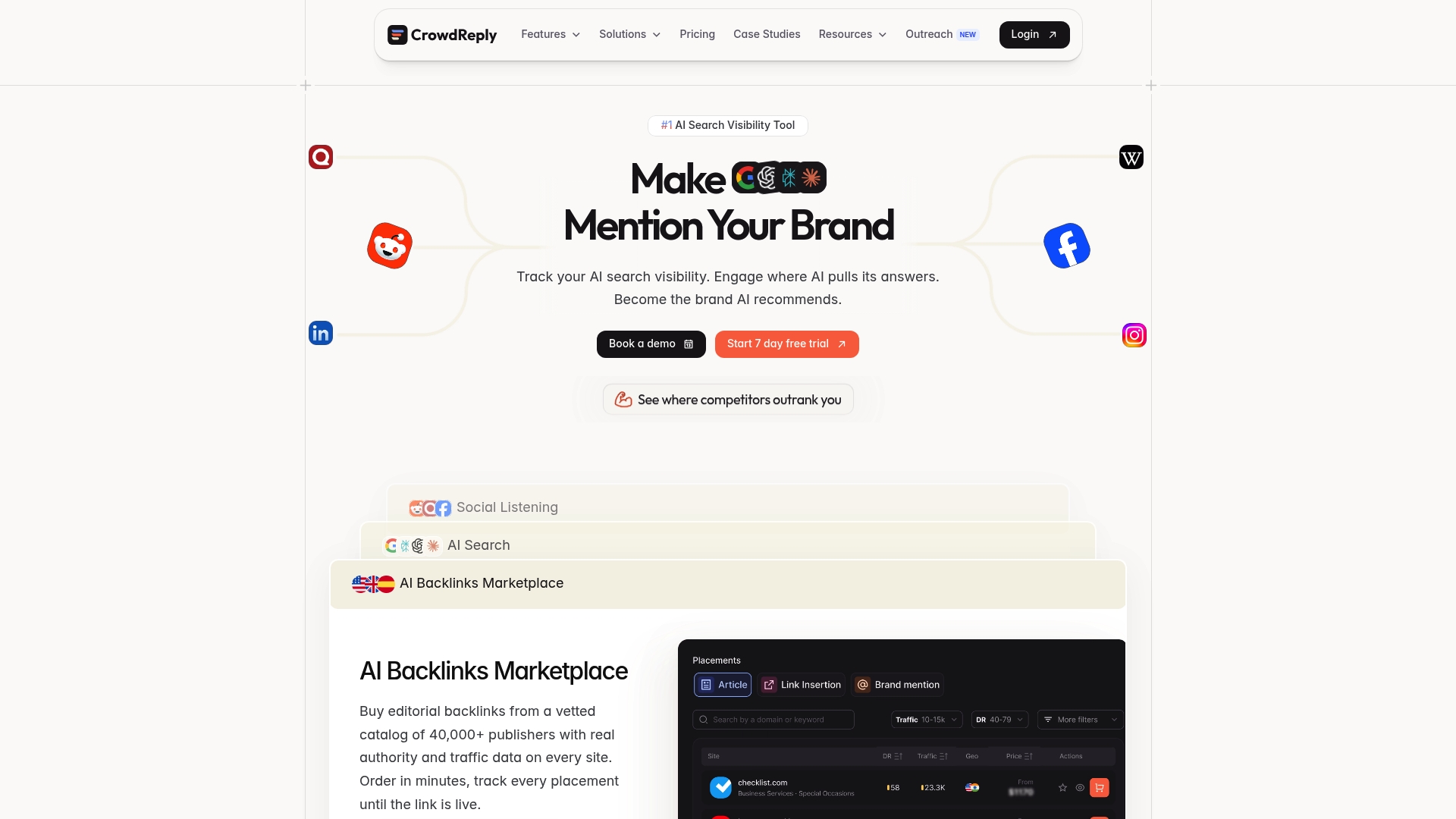
The platform’s prompt research tools surface the exact queries where your brand is missing, mapping directly onto the audit priorities covered above. When the gap is earned authority specifically, the AI Backlinks Marketplace connects you to vetted sources for citation outreach instead of leaving PR as a guessing game. Crowdreply’s own positioning is built around this gap: most tools track visibility, but few let you act on it by engaging directly with the sources AI already cites.
If you want a baseline before committing to anything, run the free AI visibility check first. From there, plans start at $79 a month on the Starter tier, scaling up to Growth and Enterprise as your citation-tracking needs grow.
Sources
- Weakly supervised veracity classification with LLM-predicted credibility signals
- Authority and Provenance Signals: Named Authorship, Methodology Sections, and Source Citations in AI Trust Evaluation — SIGI
- W3C Credibility Signals
- Schema
FAQ
What Is the 30% Rule for AI?
There’s no single, universally recognized “30% rule” governing AI trust signals or AI-generated content thresholds. If you’ve seen the term applied to content mixes or disclosure requirements, treat it as an informal guideline rather than an established standard, since no authoritative body defines it this way.
Can AI Give Trading Signals?
AI models can generate market commentary and pattern-based observations, but trust-signal principles still apply: verify the provenance behind any claim before acting on it. Financial content carries higher stakes than most categories, so named authorship, methodology disclosure, and sourced data matter even more here than in general marketing content.
What Is the AI Trust Paradox?
The AI trust paradox refers to the tension between how confidently AI systems present answers and how verifiable those answers actually are. Marketers can reduce that gap on their own content by publishing verifiable provenance, methodology, and named authorship, the same signals research identifies as top-ranked for citation decisions.
Is Signal AI Legit?
This article covers AI trust signals as a category, meaning the credibility markers models use to decide what to cite, rather than any single named product called “Signal AI.” For monitoring and closing gaps in your own AI visibility, platforms like Crowdreply track citation rate and earned mentions across ChatGPT, Gemini, and Perplexity in one dashboard.
How Much Does Crowdreply Cost?
Crowdreply’s Starter plan runs $79 per month, Growth is $239 per month, and Enterprise starts from $399 per month, with a free visibility check available before you commit to any tier.
Leave a Reply